
Aumanufacturing

Despite disappointments, this founder is still adamant about high-tech gear made here
Appreciation has grown in the last decade or so for a modern, holistic view of manufacturing. It’s “more than just production”, you will have heard countless times, and production is the lowest point in the “smiley curve” model of where value is added.
The National Reconstruction Fund Corporation, for example, chose to open its inaugural newsletter this month by sharing that it defines manufacturing based on this model.
That said, it can be difficult to focus on the positives, or the other bits of the value curve, when production of an Australian-developed technology moves elsewhere.
Jeff Lang, CEO and Executive Director of waste management tech business Vortair, has felt the sting of offshoring.
After beginning his career in signwriting, his passion for competitive snowboarding in the sport’s early days turned into building boards at his dad’s factory, then founding Force Industries in the mid-1990s and making skis, snowboards and kite boards at Melbourne.
“That factory – we ended up losing that, because my partners had some investment in. They wanted to move to China,” Lang tells @AuManufacturing.
“I did everything to try and oppose shipping that off to China, that capability, but we ended up doing it. So that was back in 2004 we shipped over to China and then by 2007 I’d built the largest ski factory in the world.”
Lang’s commercial success led to an approach by CSIRO in 2007 as part of the organisation’s efforts to add more value to Australia’s rich titanium ore resources, rather than selling them off as low-value titanium dioxide.
Cold spray additive manufacturing emerged as one area of potential. The process uses gases to accelerate titanium and other metal particles to supersonic speeds, where they fuse together on a substrate without needing to be melted with lasers.
“At that time the only tech it was being used for was in Japan to spray rice cookers with a specialised coating,” recalls Lang.
After years of development and identifying where the technique had its best chance of impact, Lang founded Titomic with oncologist Professor Richard Fox in 2014, before an IPO in 2017.
We will fast-forward a few years and several different roles at the company to Lang’s departure in 2022. Then a little further to June this year and the bit about Australian-developed technology assembled in overseas factories.
The US’s pull as a defence and aviation market – the biggest sectors of potential for Titomic’s tech – was undeniable. If the company lived up to its potential, at least some of its machines were always going to be made there, says Lang.
A factory opening in June came with some heartache, however.
“Probably the most upsetting thing I’ve seen is a recent announcement where they say ‘Titomic: made in Alabama.’ [Laughs] … How do you sort of even digest that?” he asks.
“So it is a bit of a slap in the face, that bit. To work so hard to build capability, with Australian investors, great Australian technology, representing sovereign capability, to watch that go offshore. So it is very upsetting, but at the same you’ve got to be pragmatic. The world moves on.”
Lang says he was upset to discover that Titomic moved all its production to the US. (It also runs a new site in The Netherlands and another at Melbourne’s Mount Waverley, described to investors in July as a “Modern, functioning incubator facility”.)
Titomic’s characterisation differs from Lang’s. Asked about redundancies at Melbourne as a result of the Huntsville opening, it answered: “Headcount in Australia has been maintained to support rising customer demand across the Asia-Pacific region and to support the United States expansion efforts.”
It maintains that there has been “no change to [the Mount Waverley site’s] manufacturing responsibilities in Australia” and that Huntsville “reflects increasing global demand and is an addition to, not a replacement for” Australian operations.
At any rate, its repositioning after a $50 million capital raise last month is unambiguous.
In a June 3 release to mark the ribbon-cutting at Huntsville, its country of founding was mentioned only at the bottom, to describe Titomic as being “a publicly listed Australian company”.
On July 25, the company info small print was further tweaked to define Titomic as, among other things, “a leading American manufacturing company” though also with a “local presence in… Australia and Europe.”
Lang concedes some residual sourness, but as a major shareholder his wishes that the company be successful are likely sincere.
(As a footnote, Titomic has an application for a $5 million Industry Growth Program grant currently under review. It also intends to seek backing from the National Reconstruction Fund Corporation, which can only invest in proposals “solely or mainly Australian-based”. Asked about whether it could potentially back an American manufacturing company, the NRFC said it would depend. More information was needed, and it couldn’t offer an opinion on eligibility “based on a hypothetical.”)
Meanwhile, the Titomic founder has not given up on the dream of making world-leading machinery in Australia.
A few years back, CSIRO linked Lang up with a tiny Melbourne enterprise focussed on shredding metal swarf into powders. After an approach to buy the company through Titomic fell through, Lang eventually formed Vortair with inventor Axel Andre and Tom Denby in 2024.
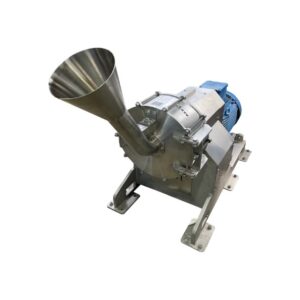
A Vortair milling machine
He describes their machines as able to mill fine particles of between 5 and 75 micron through “autogenous grinding”. Lang believes it offers usefulness across a giant collection of materials and in applications including recycling glass, creating carbon black from char, and harvesting more nutrients from produce.
“It’s basically like a tornado effect: you put material in this tornado and it breaks the covalent bonds of material,” explains Lang.
“At the end of the day it’s just like a tornado there spinning around, the material that’s within that hits itself and actually reduces in size.”
Progress so far has been sustained through private investment and revenues. Lang mentions plans to establish separate divisions and form joint ventures as Vortair expands.
He says the company has established a strong supply chain and seen plenty of interest without spending much effort on marketing, and is optimistic about building many machines for export customers.
“It’s a great position to be in, but once again, what I’m adamant about this time – and passionate about – is sovereign capabilities,” he says.
“We’re not going to lose this one out of Australia. It’s going to stay firmly on the ground here.”
In this episode of @AuManufacturing Conversations, Lang shares plenty of detail about the highs and lows of manufacturing entrepreneurship, why the industry needs better leaders and to stop blaming others for its difficulties, and more.
Episode guide
0:33 – Athletics aspirations and abandoning them to do a trade in signwriting.
1:32 – The early days of automation and digitisation. “I’ve been lucky and in the right place at the right time with my age.”
3:05 – The emergence of snowboarding in Australia and making boards in the mid-1980s.
3:52 – Founding Force Industries and making skis, snowboards and kite boards.
4:32 – Reluctantly offshoring to China in 2004.
6:05 – Being approached by the CSIRO in 2007 to work on cold spray additive manufacturing for sports products, then realising the market potential was in other industries.
8:15 – Partnering with Professor Richard Fox, an oncologist, at Force Industries and then at what would become Titomic.
9:40 – IP, CSIRO, wifi and parking a patent with them.
11:05 – An unusual offer from the UK to buy their patent.
13:15 – Raising capital, deciding on a direction for the company, and being approached by Innovyz.
14:30 – Reasons why Titomic listed publicly. “We went to market with nothing more than a patent.”
16:38 – The disconnect between the big investors and most manufacturing in Australia.
17:33 – The national weakness around value-adding and two theories on why it exists.
20:20 – Stepping aside to become CTO to progress the manufacturing readiness of cold spray.
21:20 – The gap between a founder’s passion and the board’s expectations.
22:10 – Printing a tank and other projects resulting from discussions with prime defence contractors.
23:30 – A change of board and direction following the 2020 capital raise. “We did over-corporatise too quickly.”
24:40 – The bulk of the market was in the US and Europe, so it’s necessary to set up there.
25:58 – Leaving in 2022.
26:30 – “What upset me the most…”
28:40 – People want to point fingers and apportion blame.
29:30 – It’s unfortunate the mining sector has lost interest in value-adding.
30:25 – What’s lacking in Australia is fortitude and leadership from the manufacturing industry.
31:50 – “We should have the cheapest energy in the world.”
33:37 – Vortair and becoming aware of its founder’s work via CSIRO’s interest in metal swarf milling.
35:02 – Making an offer to buy the patent earlier and the deal collapsing.
35:42 – The inventor, Axel Andre.
36:30 – Building a powdering system for an unnamed tomato processor in New Zealand.
38:06 – Waste to value in tomato processing and elsewhere.
39:25 – Grinding kerbside glass.
40:55 – Why being able to mill various substances into tiny particles is useful.
42:30 – Milling insect larvae. Making carbon black from pyrolised car tyres.
43:40 – “Resource carbon black” from municipal waste rather than petrochemicals.
45:10 – Financing the company privately. Plans to create different divisions within Vortair for different industry problems. Potential joint ventures.
47:20 – Considerations around manufacturability, robustness, food safety, supply chain and other requirements.
48:45 – Praise for SEW Eurodrive as a supplier. (Full disclosure: SEW is an advertiser with this title.)
51:10 – A pet issue: a lack of commercial thinking among startups.

🌍 World
Worldwide Players
Except Australian players

📰 News
Latest Updates
Loading latest news…
More in this section




@aumanufacturing Sections
Analysis and Commentary Awards Casino reviews Defence Gambling Manufacturing News No deposit Bonus codes Online Casino Podcast Technology Videos