

Sponge-like gold particles could be used to triage women with suspected ovarian cancer more accurately than current diagnostic tools, according to the University of Queensland. A project led by UQ PhD student Javeria Bashir has produced specially crafted, sponge-like mesoporous gold nanoparticles that can highlight cancer markers in samples like urine, saliva, or blood, with hopes that these can help improve survival rates for a cancer that is considered particularly deadly. With experts from several of the university's departments, Bashir sought to improve cancer diagnostics by using the unique biosensing capabilities of nanoparticles, and was able to boost the sensitivity of gold-enhanced light sensors using a technique called Surface-Enhanced Raman Scattering (SERS). “Essentially, the gold particles act like tiny light amplifiers, creating hotspots that reveal even the faintest traces of cancer,” she said.
Ms Bashir said the gold could be embedded in the diagnostic process with a small tube to hold the patient sample and a handheld Raman spectrophotometer.
Ten Years Of Life-changing Medical Research Future Fund
The decade anniversary of the Medical Research Future Fund (MRFF) was marked this week. Funding from the MRFF has so far supported over 1,690 Australian-based research projects, resulting in life-changing new innovations and treatments which have transformed and saved people's lives. The MRFF is an endowment or capital preserved fund, currently valued at $24 billion. Earnings from the fund provide a perpetual stream of funding for research, with the co-existence of the MRFF and the Medical Research Endowment Account (MREA), together awarding more than $1.5 billion in research grants each year. “The 10-year anniversary of the MRFF is a significant milestone and a reminder of its enduring impact on Australian health and medical research,” said federal health minister Mark Butler.
AFL great joins Lovells as Brand Ambassador
Australian suspension and towing components manufacturer Lovells Group has announced the appointment of AFL Hall of Fame inductee Brent “Boomer” Harvey as its official Brand Ambassador. In a statement this week, Lovells said the announcement forms part of its 95th anniversary celebrations and brand relaunch. Harvey holds an AFL record of 432 games played, “a benchmark for endurance and commitment that remains unmatched nearly a decade on”, said the company. Simon Crane, Managing Director, of Lovells Group, said: “He’s not just a sporting great – he represents performance under pressure, consistency, and loyalty. We’re thrilled to welcome him to the Lovells family as we mark 95 years of manufacturing excellence.”
Australia moves toward Horizon Europe membership
The Australian government has said its decision to enter formal negotiations with the European Union for associate membership to Horizon Europe represent “a major milestone in unlocking the potential of Australian research and development”, according to the Group of Eight universities. Horizon is the EU’s €95.5 billion (approximately $169 billion) flagship research and innovation program, the world’s largest collaborative R&D platform. The membership would place Australian universities, businesses, and researchers “at the heart of global innovation—accelerating breakthroughs that directly impact health, technology, sustainability, and national wellbeing.” The Go8 has advocated for this for almost a decade, it said. CEO Vicki Thomson said on Wednesday, “This is a pivotal decision and an important first step. Our future prosperity, national security, and global influence depend on our ability to be at the forefront of international research and innovation.”
Pectin 360 awarded $2.1 million CRC-P grant
Pectin 360 was among Cooperative Research Centres Projects (CRC-P) Round 17 winners, announcing last week that it has been awarded a $2.1 million grant to support development of Australia’s first onshore pectin and fibre production. The company said Pectin is an essential ingredient used in a wide range of food and nutraceutical products, yet currently all of it used in Australia is imported . The grant will help Pectin 360 build a pilot-scale plant ($4.9 million project) to validate its zero-waste manufacturing process, converting fruit waste into high-quality pectin and fibre. Project partners include Doehler Australia, Ahurei, Royal Melbourne Institute of Technology (RMIT), Frunutta Asia Pacific and Scimita Operations. “This funding will allow Pectin 360 to accelerate commercialisation activities and materially de risk the business case. Together with our partners, we aim to create a cost-competitive, domestic alternative to imported pectin and fibre,” said Martin Kaderavek, Co-Founder and CEO of Pectin 360.
Courses begin on Australian-made tank simulators
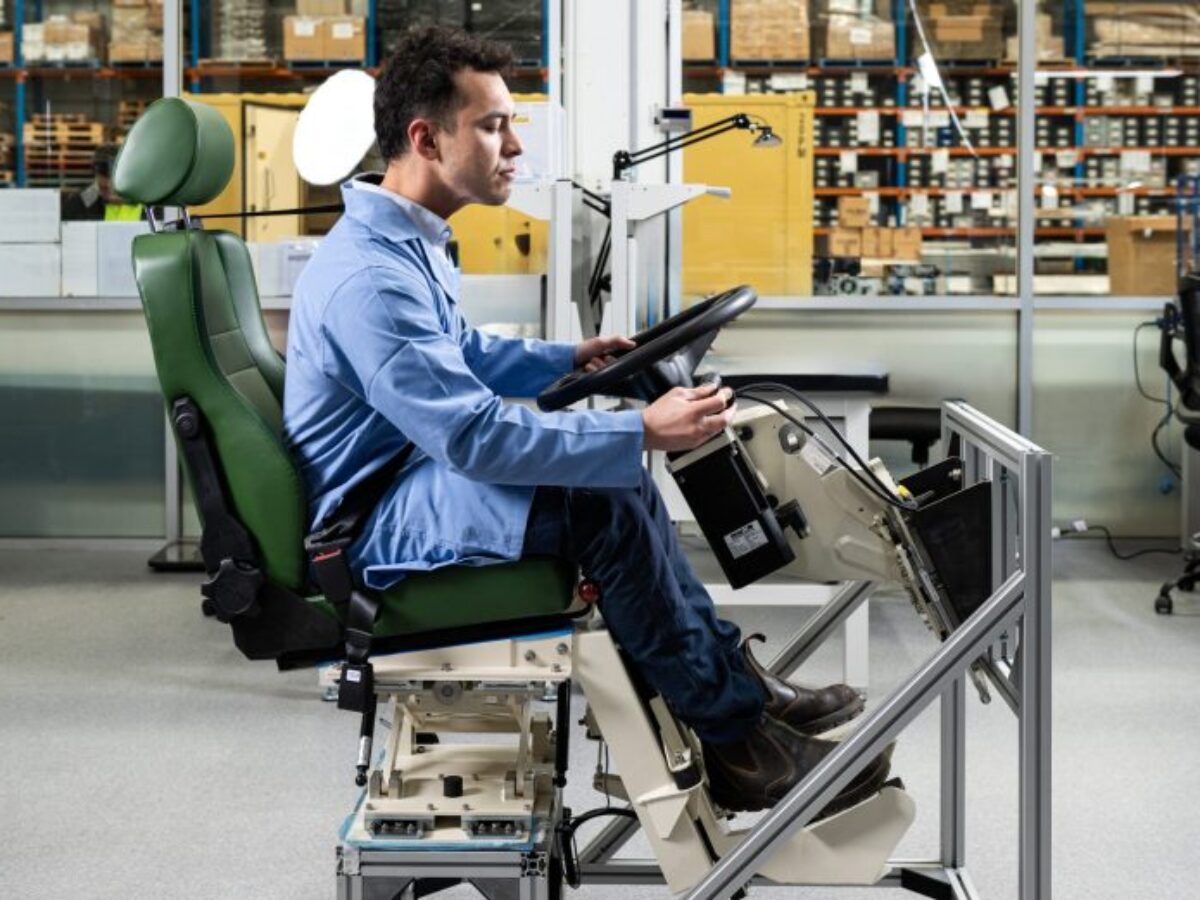
Sixteen new Australian-made simulators are training soldiers on their transition to the new M1A2 Abrams main battle tank Defence announced on Thursday. Approximately $60 million was invested in the simulators, designed and built by Australian defence industry in a project led by Thomas Global Systems Australia and creating over 60 jobs, according to the statement. The M1A2 Immersive Tactical Trainers replicate the inside of a main battle tank, “and are comparable to flight simulators in both sophistication and functionality”. They offer flexible training modes – either under the control of an on-board instructor, or through networked scenarios for collective training. Courses on the new simulators have begun in training schools. “Thomas Global Systems Australia has given us the capability to simulate training in a 70-tonne main battle tank, almost anywhere in the world,” said Head Land Systems, Major General Jason Blain.
Picture: credit Thomas Global Systems