
Aumanufacturing


Manufacturing news briefs — stories you might have missed
Archer, CSIRO collaborate on QML for fraud detection
ASX-listed semiconductor developer Archer Materials has entered into a research services agreement with the data and digital specialist arm of CSIRO, aiming to develop a quantum machine learning (QML) system designed to detect fraud in financial transactions. The project is scheduled to run this month until November 2026, and will focus on developing “QML models to enhance the detection of fraudulent activities in financial transactions, with initial outcomes including prototype quantum models and performance benchmarks across simulated financial datasets.” These models “may be capable of detecting fraud in financial transactions” Archer said. “Once QML models are trained, the fraud detection framework will rapidly identify and flag any anomalies which arise from fraudulent activities.” It added that hybrid quantum-classical machine learning models that adapt classical neural network architectures for quantum computing can enable applications beyond fraud detection, and it is conceivable that the technology can be adapted for other applications.
UNSW innovation could improve global solar manufacturing costs “by billions”
Last week University of NSW announced that its researchers will work with its spinout company, BT Imaging, to accelerate commercialisation of solar cell defect detection technology, backed by a $400,000 grant from the Trailblazer Recycling & Clean Energy (TRaCE) Lab to Market Fund. The commercialisation project with a $1.4 million total value focusses on a “breakthrough contactless inspection system developed at UNSW”, which could “revolutionise” solar cell testing, quickly “become the new global standard”, while “cutting waste, doubling production speed and saving the photovoltaic industry an estimated $US1.4 billion a year.” Project lead, Professor Ziv Hameiri, said, “we aim to reshape the industry by introducing contactless measurements that overcome the limitations of standard current-voltage testers, while offering lower cost, higher throughput and importantly, new insights that will make solar cells even more efficient and reliable.”
Heads of CSIRO's manufacturing and Data61 divisions quit: report
Information Age reported on Friday that the directors of CSIRO's Data61 division, Dr Jon Whittle, and its manufacturing arm, Dr Marcus Zipper, will both leave their roles at the end of this week (November 14.) The publication cited an email to staff and sent last Wednesday, and a spokesperson who said in a statement that “CSIRO acknowledges the valuable individual contributions Dr Zipper and Dr Whittle have made to the organisation and wishes them well in the future”. Neither the CSIRO Staff Association, Whittle, or Zipper responded to an enquiry, according to IA.
NSW to phase out single-use plastics and chemicals
The NSW government announced the next phase of single-use and problematic plastic phase-outs on Sunday, the eve of National Recycling Week. According to the statement, the state faces a waste crisis, with Greater Sydney is set to run out of landfill space by 2030 without action. The NSW Plastics Plan will target unnecessary and hard-to-recycle plastic products, while encouraging “new investment in recycling infrastructure and reusable products”. Also flagged was development of a green and red list of chemicals, identifying chemicals “to phase out which are known to cause problems for human health and the environment, and which have safer alternatives already in use.” Environment minister Penny Sharpe added, “The great news is that industry is already moving this way – many businesses are leading the way in developing alternatives to single-use plastics. We will continue to work with industry, small businesses, manufacturers, retailers and councils to support a smooth transition to safer, recyclable alternatives.” The plan can be viewed here.
ARENA backs Fortescue on Pilbara Solar Innovation Hub
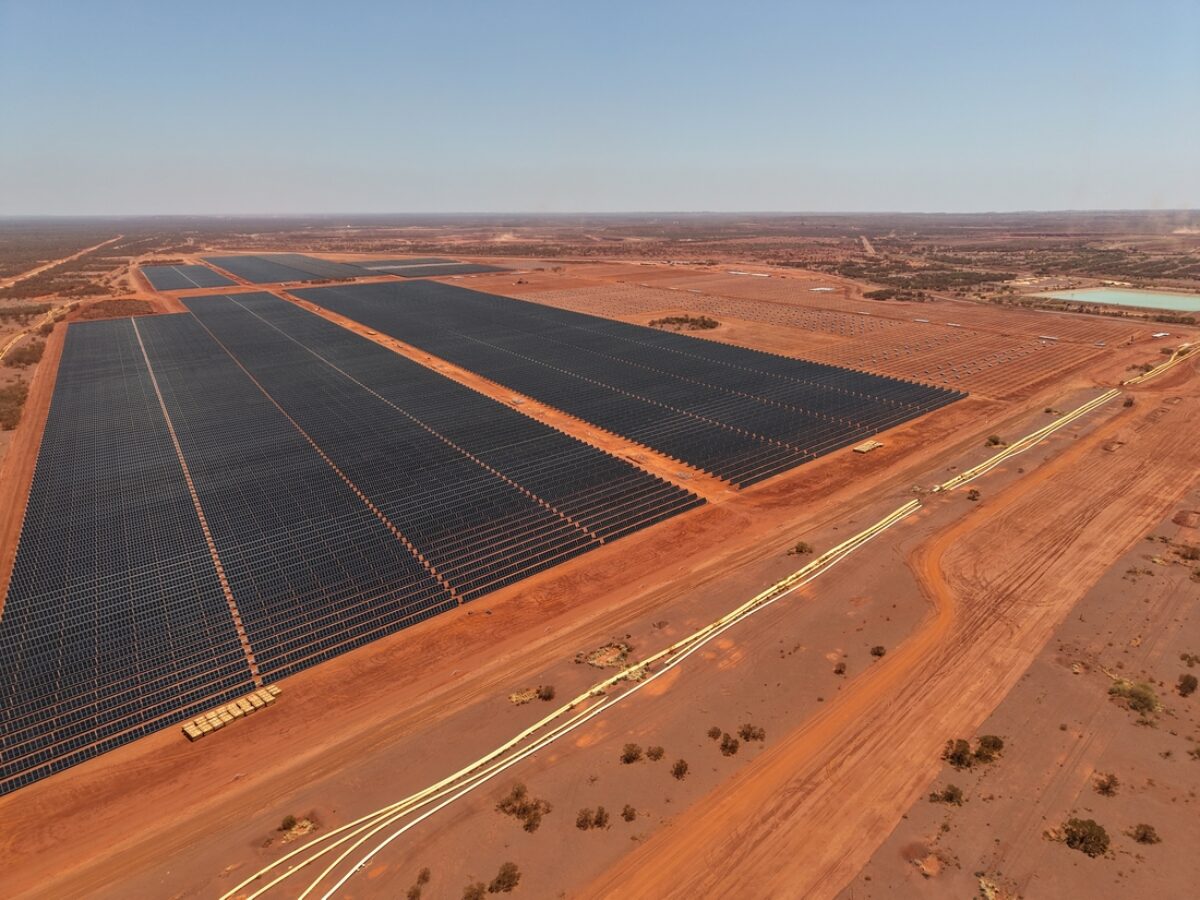
Fortescue announced on Monday that the Australian Renewable Energy Agency (ARENA) has made available $45 million in funding to fund an initiative with Fortescue to develop a Pilbara Solar Innovation Hub. The funding from ARENA's Advancing Renewables Program will trial emerging technologies operating across Fortescue’s growing renewable energy portfolio, including the 190-megawatt Cloudbreak solar farm which is now over a third through construction. Fortescue Chief Executive Officer Metals and Operations, Dino Otranto, said: “The Solar Innovation Hub will allow us to trial and refine new technologies that improve safety, speed up delivery and drive down costs – helping us and Australia accelerate the transition to green energy.” One of the first projects supported under the Hub is a technology trial with Built Robotics, testing autonomous piling systems for constructing solar farms at Cloudbreak. Fortescue said it is also progressing work with Australian-based solar company 5B to trial its prefabricated Maverick system.
Shortages are possible this summer, warns Refrigerants Australia
The industry body for the refrigerants supply chain, Refrigerants Australia, has cautioned that this summer could bring “widespread shortages and significant price increases for refrigerants” used in commercial settings. Smaller businesses could face “severe cost pressures and operational disruptions”, with larger clients like supermarkets and large-scale operators shielded by long-term supply contracts. The group said legislation was introduced by the federal government in 2017 to phase down refrigerants with a high global warming impact to encourage a gradual transition to newer, lower-impact alternatives, though this didn't happen. “Industry has been urging the Government since before COVID on practical ways to reduce refrigerant demand and improve performance across the sector, while also saving consumers money,” said Greg Picker, Executive Director of Refrigerants Australia.
Picture: Cloudbreak solar farm (credit Fortescue)

🌍 World
Worldwide Players
Except Australian players

📰 News
Latest Updates
Loading latest news…
More in this section




@aumanufacturing Sections
Analysis and Commentary Awards Casino reviews Defence Gambling Manufacturing News No deposit Bonus codes Online Casino Podcast Technology Videos