
Aumanufacturing
Thermoplastic Elastomers (TPE) – six major types and their applications
Sponsored article
Elastomers are materials that can return to their real shape when the external force is removed. Not all elastic materials are elastomers.
There are thermoplastic elastomers and thermosetting elastomers. Thermosetting elastomers are traditional rubber. In domestic habits elastomers are usually known as thermoplastic elastomers and, as a result, rubber might sometimes be excluded from the meaning of rubber in technical communication.
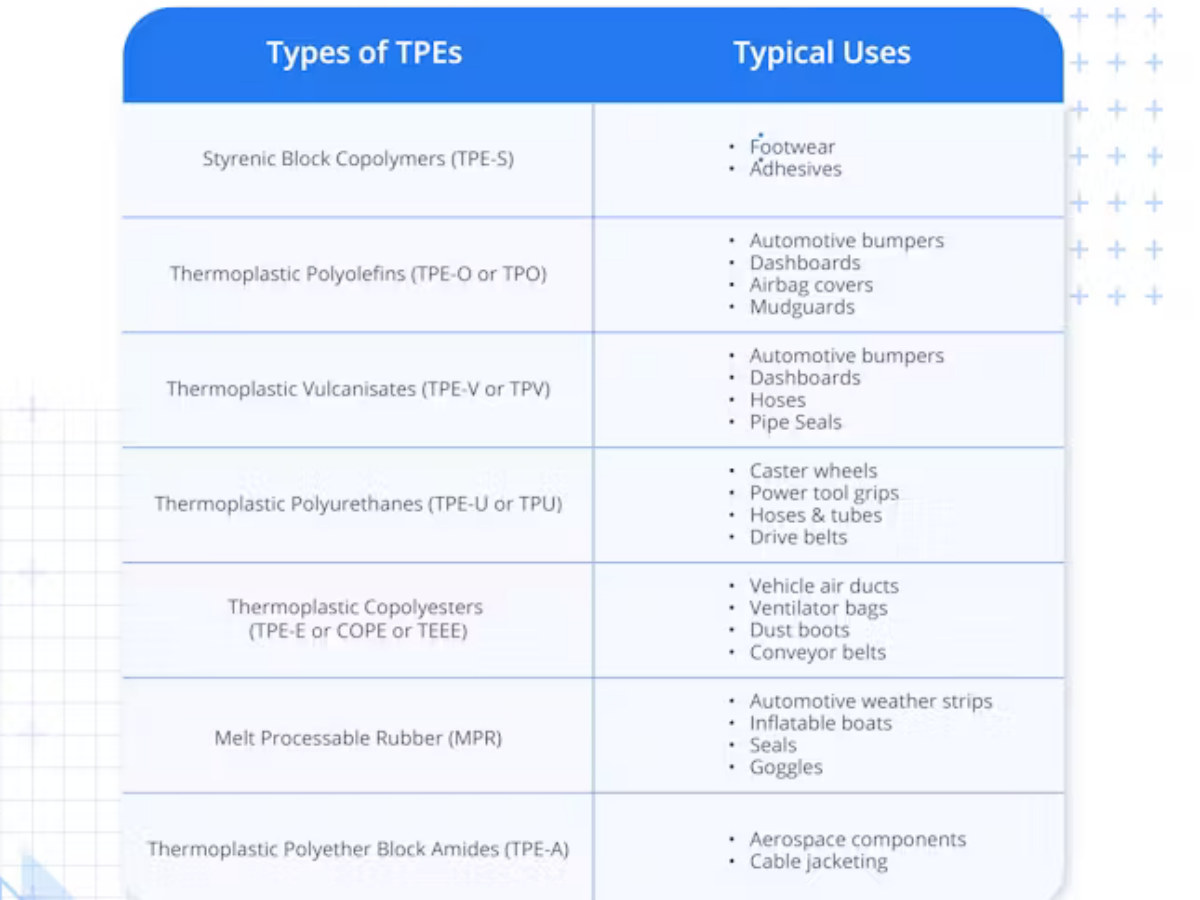
The various types of thermoplastic elastomers and their application fields will be discussed in this article. Read with the understanding that if something is missing, it is open to addition through a comment.
Specifically, thermoplastic elastomers (TPE or TPR) are sometimes referred to as SBS (styrene butadiene styrene). However, thermoplastic elastomers do not have a single name around the world. They are usually abbreviated in English as TPE, except for most of the time. Several types of thermoplastic elastomers (TPE) are as follows:
1. TPU – Thermoplastic Polyurethane Elastomer
Thermoplastic Polyurethane (TPU) is an elastomer with the polymerization of high and low-molecular-weight polyols and chain extenders by MDI or TDI isocyanates. It is of three types according to its soft segment structure, polyester based (having ester groups), ether based (having ether groups), and butadiene based (having butylene groups). Being a balance of flexibility, durability and chemical resistance, the TPU is well suited for different uses, such as footwear, automotive parts, medical equipment, and machines. Being thermoplastic, processing is easy, i.e. injection molding and extrusion, and it has excellent elastomeric properties, e.g. good abrasion resistance and elasticity. Thankfully TPU is very versatile, and tough, yet it will take a beating.
1.1 Polyester-based TPU:
Features: High strength, good hydrolysis resistance, high rebound elasticity, low temperature performance, good wear resistance, oil resistance, and excellent compression set resistance.
Applications: Footwear, clothing, conveyor belts, pipes, seals, automotive parts, hydraulic hoses, corrugated pipes, cables, blended modification, electronic injection molding, etc.
1.2 Ether-based TPU:
Features: Pleasant hand-feel, excellent hydrolysis resistance, low temperature flexibility, antibacterial properties, aging resistance and weather resistance.
Applications: Flat hoses, fabric coatings, cable sheaths, films and sheets, animal ear tags, smart watchbands and appliqué materials.
2. TPS – Styrene-based Thermoplastic Elastomer
Thermoplastic Styrene Elastomer (TPS) also referred to as Thermoplastic Elastomer Styrene (TPES) is a styrene based copolymer with elastomeric properties. It is a styrene and other monomers based material with flexibility, resilience and easy processability. There are four types of TPS classes based on the structure of its copolymer: Styrene-Butadiene-Styrene (SBS), Styrene-Ethylene-Butylene-Styrene (SEBS), Styrene-Isoprene-Styrene (SIS) and Styrene-Ethylene-Propylene-Styrene (SEPS). The variations offer different levels of elasticity, strength and chemical resistance, and TPS is suited for application in adhesives, footwear, automotive parts, and consumer products. Easy recycling and reshaping goes along with it being of a thermoplastic nature, but at the same time it has elastomeric properties to ensure its durability and impact resistance. The excellent balance of flexibility, toughness and weather resistance make TPS widely used.
2.1 SBS – Styrene-Butadiene-Styrene:
SBS or Styrene-Butadiene-Styrene is a copolymer of styrene and butadiene, and it is the most used type of the TPS family. It is similar to rubber, is not affected by water, weak acids and alkalis, and is tough. It has high elongation strength, good abrasion resistance, good low temperature performance, good electrical properties and good processability.
Applications: Shoe soles, rubber hoses, tapes, adhesives, asphalt modifiers, daily products, and waterproof membranes.
2.2 SEBS – Hydrogenated SBS:
The saturated SBS (SEBS) is a hydrogenated form of SBS. It is more difficult than SBS, with higher tensile strength, good light, aging, and low temperature resistance.
Applications: Daily products (stationery, toys, sports equipment), cable protection, medical devices, adhesives and sealants, engineering plastic compatibilizers and toughening agents.
2.3 SIS – Styrene-Isoprene-Styrene:
SBS is a block copolymer of styrene-block-isoprene-block-styrene, a sister product of SIS. It has a good bond strength, good solubility resistance, good low temperature performance, and is excellent in elasticity. However, it has worse oil, solvent and heat resistance.
Applications: Hot-melt pressure-sensitive adhesives, medical bonding, electrical insulation and packaging
2.4 SEPS – Styrene-Ethylene-Propylene-Styrene:
SEPS is a styrene, ethylene, propylene, and styrene block copolymer. It has better mechanical properties, lower temperature performance, insulation, heat resistance, chemical corrosion resistance and oil resistance than SEBS.
Applications: Adhesives, sealants, engineering plastic modifiers, cable filling compounds, automotive lubricants, and cosmetic grade petroleum jelly thickening agents.
3. TPO – Thermoplastic Olefin Elastomer
Thermoplastic Olefin (TPO) is an elastomer produced by copolymerization of ethylene with propylene or other olefins such as 1-butene, 1-hexene, or 1-octene. It provides good impact resistance, durability and weather resistance and combines processability of thermoplastics with flexibility of rubber. Because it is lightweight and high performance, TPO is used widely in automotive parts, roofing membranes and industrial applications. They also include Polyolefin Elastomers (POE) and ethylene vinyl Acetate (EVA), which are also similar in properties. TPO materials are known to be recyclable, UV resistant, and chemically stable, which makes them a good material of choice for tough and environmentally resistant applications. They also can be molded, extruded, and welded and they are versatile in many different industries.
3.1 POE – Polyolefin Elastomer:
It is a thermoplastic elastomer that is obtained by copolymerizing ethylene and octene with metallocene catalysts. It has good toughness, processability, aging resistance and flowability, and good compatibility with polyolefins.
Applications: Footwear, cable protection, toys, toughening agents, high grade hot-melt adhesives, flame retardant masterbatches, film additives, and modifiers.
3.2 EVA – Ethylene-Vinyl Acetate:
The copolymer of ethylene and vinyl acetate is called EVA. You should note that EVA elastomer is only when the VA content is between 40 per cent and 70 per cent. If the VA content is less than 40 per cent, EVA is used as a modification material, thin film or cable material. At high VA content, EVA becomes liquid and is mostly employed in adhesives and coatings.
Applications: Footwear, PVC modifiers, toys, sports equipment, automotive interior materials.
4. TPV – Thermoplastic Vulcanizate Elastomer
Typically, thermoplastic vulcanized rubber (TPV) is made by melting, blending and vulcanizing vulcanized rubber with plastic. TPVs can be formed from many plastics and rubbers, but only a few of the latter blends become commercially viable after dynamic vulcanization. The most commercially available TPVs at present are PP/PE/EPDM blends.
4.1 PP/PE/EPDM:
The thermoplastic vulcanizate (TPV) PP/PE/EPDM is a polypropylene (PP) continuous phase and EPDM rubber dispersed phase. Excellent elasticity, temperature resistance, electrical insulation and aging resistance make it dominate over 90 per cent of TPV production. The biggest advantage of TPVs is that they are easy to color, comfortable to the touch, and surprisingly durable.
Applications: They are also used in automotive door seals, floor mats, dust covers, cable sheaths, electrical sealing components and fitness equipment handles. TPVs have flexibility and processability in a balanced way, and are suitable for applications requiring long term performance and environmental resistance.
5. TPC – Thermoplastic Polyester Elastomer
Thermoplastic Polyester Elastomer or TPC, also referred to as TPEE or TEEE, is a linear block copolymer of PBT (polybutylene terephthalate) polyester hard segments and soft segments such as aliphatic polyesters or polyethers.
Features: TPC has good compressive modulus, bending fatigue resistance, instant high temperature resistance, good tear resistance, good wear resistance and good adhesion with many engineering plastics, metals and paints.
Applications : Footwear, automotive parts, expandable telephone cables, memory pillows, hydraulic hoses, artificial leather, conveyor belts, and others.
6. TPA – Thermoplastic Polyamide Elastomer
TPA or TPAE is a thermoplastic elastomer derived from crystalline hard polyamide and noncrystalline soft segments. It is usually PA6, PA66, and PA12 types.
Features: TPA has high strength, elasticity, toughness, wear resistance, good oil resistance, heat resistance, and good processability similar to nylon.
Applications: Silicone rubber substitutes, high end footwear, automotive parts, medical tubes, soundproof gears, elastic fibers, smart wearables, etc.
Conclusion: The vast prospects of diversified applications and injection molding services
As technology continues to develop, the use of thermoplastic elastomers (TPE) can be found in various application fields, including automotive, electronics, healthcare, footwear and toys. Not only are thermoplastic elastomers outstanding performers but also their flexible processing methods. In particular, injection molding technologies for TPU injection molding, TPA injection molding, TPO injection molding, have advanced continuously, which has made the processing and application of these materials more efficient and precise.
TPE materials have proven to be the best choice in the field of injection molding for the complex structural components because they have good flow ability, recyclability and compatibility with other materials. For instance, TPU injection molding is applied to manufacture high performance seals, wear resistant parts and so on; TPA injection molding is used in automobile and electronic industries due to its heat and oil resistance; TPO injection molding is suitable for automobile interior and exterior components.
Moreover, the market for personalized injection molding services is continuously increasing. Many companies want professional injection molding service providers to design and manufacture high performance components that satisfy their product requirements. With the growing demand for high precision, high-quality injection molded products in the market, the injection molding industry is gradually undergoing smarter, environmentally friendly, and personalized development. Today plastic injection molding services are no longer confined to single product production but also include material selection, design optimization and improved production efficiency, which should be an important factor in companies’ efforts to boost competitiveness.
Topics Manufacturing News

🌍 World
Worldwide Players
Except Australian players

📰 News
Latest Updates
Loading latest news…
More in this section

@aumanufacturing Sections
Analysis and Commentary Awards Casino reviews Defence Gambling Manufacturing News No deposit Bonus codes Online Casino Podcast Technology Videos