
Aumanufacturing


Uni Adelaide researchers develop new electrolyte for stabler aqueous zinc batteries
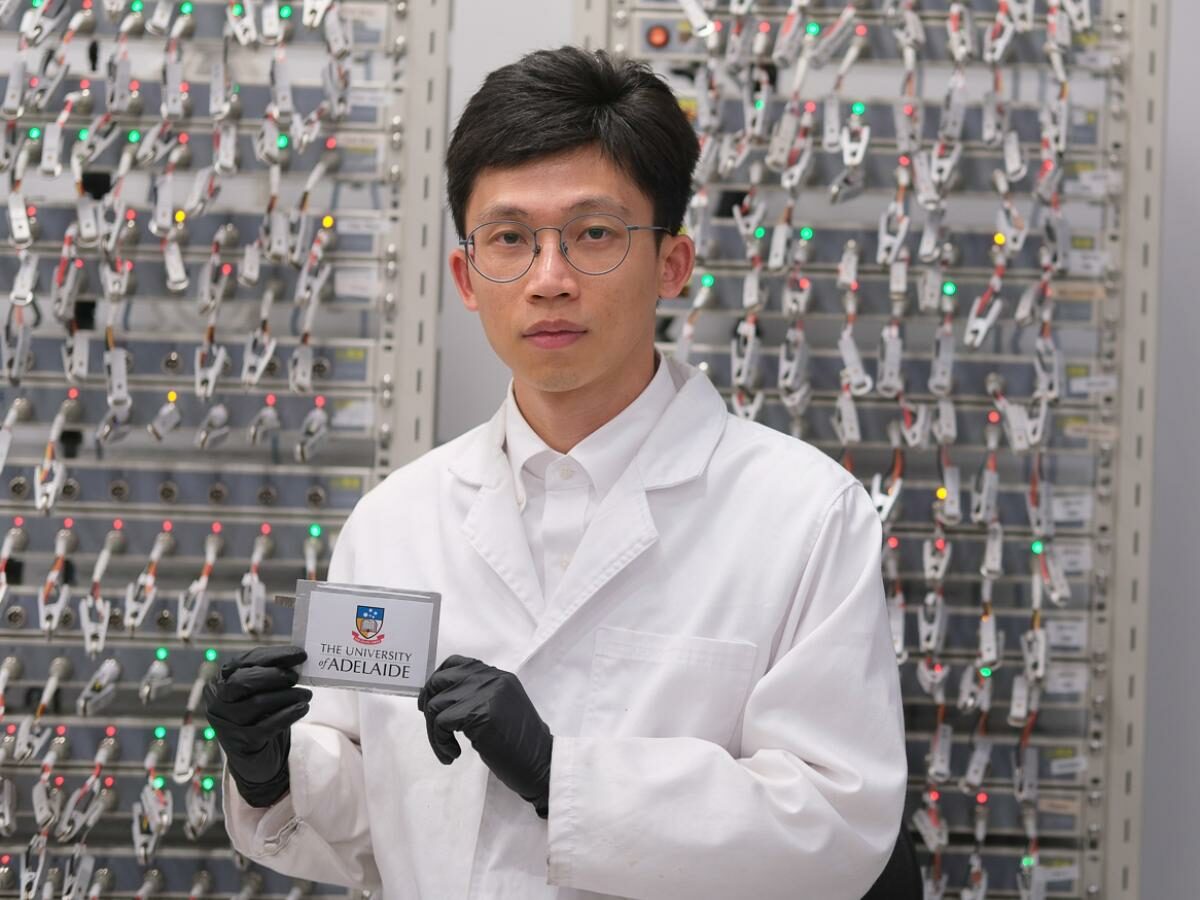
New electrolyte research led by the University of Adelaide could improve the usefulness of rechargeable aqueous zinc batteries (AZB.)
According to a statement from the university on Monday, AZBs could be an attractive alternative to lithium ion chemistries because of their non-flammability and the abundance of zinc as a resource, but are held back by limited life cycles due to a narrow working temperature range.
A new paper published in Nature Sustainability (linked) and led by Professor Zaiping Guo describes a battery electrolyte using two different zinc salts, improves the controllability of reactions between zinc and electrolytes, which limits corrosion to the battery due to released hydrogen.
The team calls its breakthrough the Decoupled Dual-Salt Electrolyte (DDSE.)
First author Guanjie Li (pictured) said one type of salt helps the battery work well in different temperatures and improves charging speed, and the other helps protect the zinc metal inside the battery.
“Together, they give the battery very good performance. It can charge quickly and work for many cycles, over a wide range of temperatures, and with very little energy loss when sitting unused,” said Li.
“In our DDSE, the first salt like zinc perchlorate, Zn(ClO4)2 stays mostly in the liquid and controls how the battery handles freezing and how fast ions move.
“The second salt like zinc sulfate, ZnSO4 sticks to the zinc metal surface and protects it from damage. Because each salt stays in its own area and does its own job, the battery works much better overall.”
Senior Research Fellow and co-author Dr Shilin Zhang added that achieving such a well-balanced performance was a first in their, and that cells kept 93 per cent of capacity even after 900 charge-discharge cycles, and worked from temperatures -40 degrees Celsius to 40 degrees Celsius.
“Our next step is to try this electrolyte in more practical battery systems,” said Zhang.
“We want to fine-tune the recipe and also improve other battery parts, so we can build a real battery prototype that has a long-life, high-energy density, and low cost.”
Picture: credit University of Adelaide

🌍 World
Worldwide Players
Except Australian players

📰 News
Latest Updates
Loading latest news…
More in this section

@aumanufacturing Sections
Analysis and Commentary Awards Casino reviews Defence Gambling Manufacturing News No deposit Bonus codes Online Casino Podcast Technology Videos