
Aumanufacturing


UNSW team’s two-for-one result gets the attention of world’s biggest solar companies
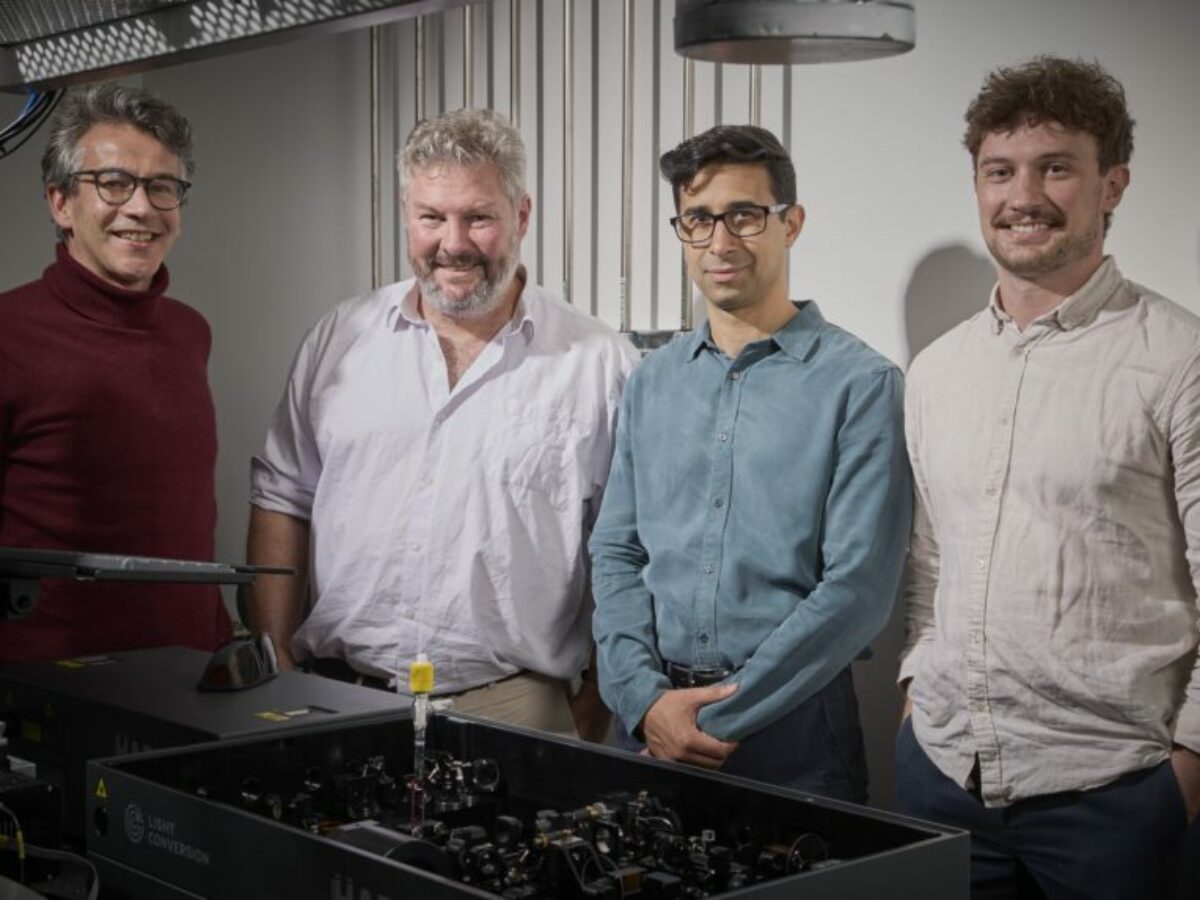
A UNSW Sydney team has made a breakthrough, showing how to create “two packets of energy” from one particle of light, which could one day see new technology “mass-produced specifically for use with solar panels”.
According to a statement from the university on Friday, the “Omega Silicon” team showed how the principle of “singlet fission” works on an organic material, demonstrating a principle that could “effectively doubl[e] the electrical output when applied to technologies harnessing the Sun.”
Their paper in ACS Energy Letters (linked) suggests a way past the current efficiency limits of silicon solar panels, with the best commercial panels converting about 27 per cent of sunlight into electricity.
“Introducing singlet fission into a silicon solar panel will increase its efficiency,” said project lead. Professor Ned Ekins-Daukes, who also heads UNSW’s School of Photovoltaic & Renewable Energy Engineering (SPREE.)
“It enables a molecular layer to supply additional current to the panel.”
The work demonstrated a compound called dipyrrolonaphthyridinedione (DPND), which could perform singlet fission, but unlike a previous candidate material (tetracene) remained stable under real-world outdoor conditions and worked outside of a lab.
“We’ve shown that you can interface silicon with this stable material, which undergoes singlet fission, and then injects extra electrical charge,” added Dr Ben Carwithen, a postdoctoral researcher at UNSW’s School of Chemistry.
“It’s still an early step, but it’s the first demonstration that this can actually work in a realistic system.”
The interdisciplinary team’s work has attracted industry attention, according to the release, with seven of the world’s biggest solar companies “watching the Omega Silicon team closely.”
Carwithen predicted that a small-scale proof of concept could be ready within years, and a big breakthrough is possible, “But a more realistic timeline is five years.”
Picture: credit UNSW

🌍 World
Worldwide Players
Except Australian players

📰 News
Latest Updates
Loading latest news…
More in this section

@aumanufacturing Sections
Analysis and Commentary Awards Casino reviews Defence Gambling Manufacturing News No deposit Bonus codes Online Casino Podcast Technology Videos